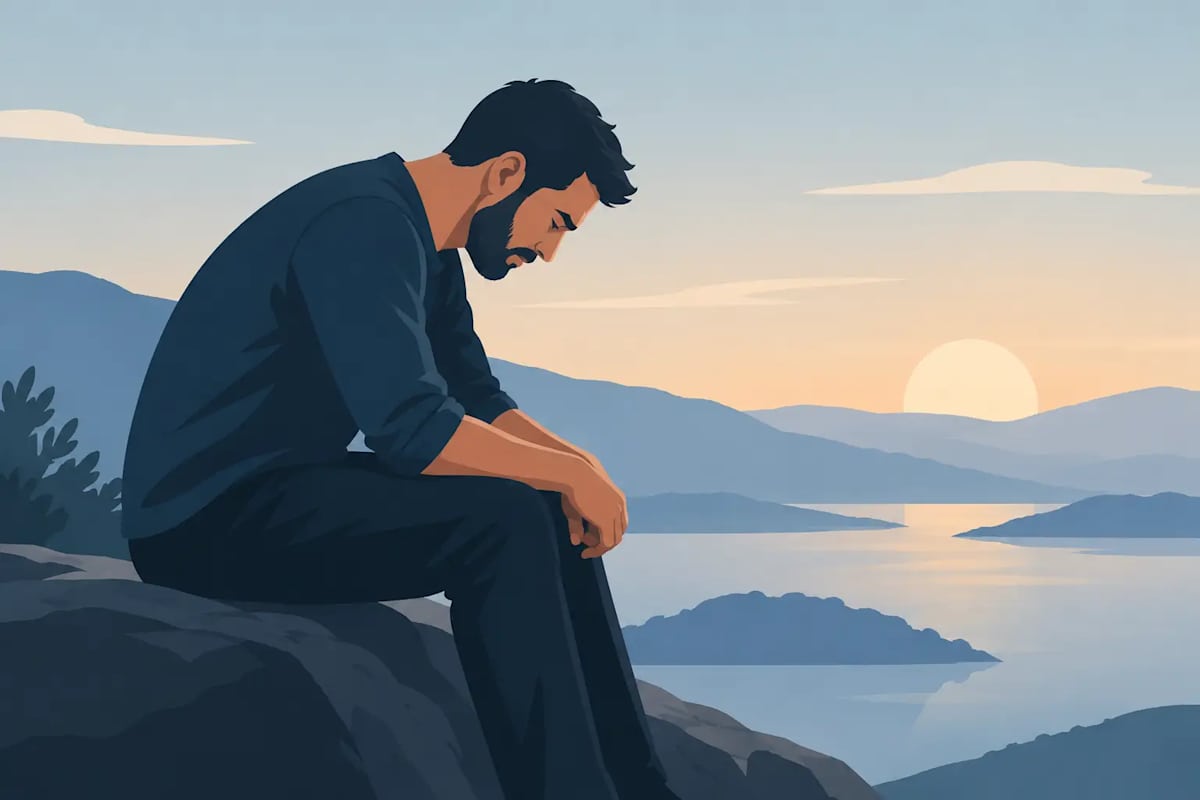
A man can be back at work on Monday, handling the calls, sorting the finances and asking everyone else whether they are alright, while something in him has quietly collapsed. This is often how male grief presents: not as visible sorrow, but as overwork, irritability, isolation, drinking, relentless training, sexual withdrawal or an inability to sit still.
He may not even call it grief. He may call it stress. He may call it a rough patch, a loss of motivation, a midlife crisis, bad sleep, or simply getting older. But grief does not require a funeral to be real. Men grieve lost fathers, marriages, careers, health, youth, status, friendships, futures they expected to have, and versions of themselves they can no longer sustain.
For many men over 40, the question is not whether grief is present. It is whether it has been given any language, space or honest witness.
Male grief is often disguised as competence
Boys are frequently taught that usefulness is their price of admission. Protect. Provide. Procreate. Perform. The message may not be spoken directly, but it is absorbed through families, workplaces, sporting cultures and the comparison-and-competition economy. Keep moving. Do not complain. Be needed. Win.
This conditioning can produce capable men. It can also produce men who only feel safe when they are achieving. When loss arrives, they respond with the one strategy that has brought approval before: more effort.
A man whose father dies may throw himself into work. A man whose marriage ends may become obsessively focused on fitness, money or dating. A man who is made redundant at 52 may tell everyone he is enjoying the break while privately feeling stripped of value. None of these responses makes him shallow or broken. They reveal a survival identity doing what it learned to do.
The trouble is that competence cannot complete mourning. Grief that has no voice does not disappear. It changes form. It may emerge as anger towards a partner, contempt for other people’s vulnerability, physical symptoms, burnout or a deadening sense that nothing matters very much.
Why men struggle to recognise loss
Grief challenges the persona many men have spent decades constructing. The Institutionalised Man learns to measure himself from the outside: title, income, physique, authority, sexual desirability, the admiration of colleagues, the behaviour of his children. When one of these measures falls away, it can feel less like disappointment and more like annihilation.
This is why male grief is rarely only about the event itself. It can awaken older losses: the father who was physically present but emotionally unavailable; the affection that had to be earned; the humiliation that was never discussed; the boy who learned that tears invited ridicule or abandonment.
Abandonment is, for many men, a life-long experience rather than one dramatic episode. It may be relational, emotional or internal. A man abandons parts of himself when he learns that tenderness, fear, dependency or uncertainty make him less acceptable. Later, when real loss comes, he may lack a relationship with the very parts of himself that need care.
This is not an argument for passive victimhood. Adult agency matters. But responsibility begins with accuracy. You cannot take ownership of a pattern you refuse to see.
The anger beneath the sadness
Anger is often more socially permitted than sadness. It creates distance, gives a temporary sense of power and stops people from asking difficult questions. Yet anger is frequently grief with armour on.
That does not mean every angry man is grieving, or that grief excuses harmful behaviour. It means the question beneath the reaction matters: What has been lost here? What expectation has died? What old wound has been touched?
This is the beginning of compassionate inquiry. Not indulgence. Not an excuse. An honest investigation.
Grief at midlife is a summons, not a sentence
Around 40 and beyond, many men encounter a difficult transition. The old motivational fuel begins to fail. Status still matters, but not enough. Achievement still provides a hit, but not a life. The body may change through stress, injury or andropause symptoms. Children need a different kind of father. Parents age. Career ladders narrow.
This can look like a crisis. Sometimes it is. Yet it can also be a summons to move from an externally managed identity towards an integrated one.
Carl Jung wrote extensively about the task of the second half of life: not simply becoming more successful at the first-half game, but becoming more whole. A man who has built a career, raised a family or carried serious responsibility has not failed because he feels unsettled. He may be confronting a developmental demand that achievement alone cannot meet.
The trade-off is uncomfortable. The old identity offered certainty, approval and a clear scorecard. The emerging self asks for ambiguity, humility and contact with feelings that cannot be solved like a business problem.
The sigma male fantasy can be a front door into this dilemma. At first, it may express a man’s wish to step outside status games and stop begging for approval. That impulse can be useful. But sovereignty is not isolation dressed up as strength. A man does not become free by needing nobody. He becomes freer when he can be known without surrendering himself.
How to meet grief without being swallowed by it
There is no fixed schedule for mourning. Every man’s life experience is a fingerprint. Change one detail in his history, and you change the trajectory. Some men need professional trauma-informed support, particularly where grief is entangled with depression, addiction, violence, suicidal thoughts or childhood trauma. Others need to begin by telling one trustworthy person the truth.
The first practice is simple and demanding: name the loss precisely. “I am stressed” is broad enough to hide inside. “I am grieving the marriage I thought I would have” is harder to avoid. “I am grieving the father I needed but did not get.” “I am grieving the athlete I once was.” Precision turns fog into something that can be held.
Then use the Socratic method on your own thinking. Ask: What am I telling myself this loss means about me? When did I first learn that this was unacceptable? Whose approval am I still trying to win? What happens if I stop performing strength for a moment?
These questions are not meant to trap you in analysis. All introspection is internal pattern recognition. The purpose is to catch the automatic sequence before it takes over: loss, shame, anger, withdrawal, more work, more loneliness.
A practical response might include three commitments. Create a regular space where grief can be felt without distraction, whether through writing, walking, prayer, therapy, men's group or quiet reflection. Tell the truth to another grounded man who will not mock, fix or compete with you. Choose one small action that restores connection to life: ring your son, make the medical appointment, sit with your partner without the mobile, return to the training that serves your body rather than punishes it.
Incremental action matters because the nervous system learns through experience. You do not reason your way out of every survival response. You show yourself, repeatedly, that feeling does not destroy you.
Men need witness, not performance
Men need men to develop. Not an audience for bravado, not a group built around complaining, and not a circle where every difficult emotion is immediately turned into a joke. They need mature witnesses: people capable of unconditional positive regard and clear challenge.
That combination is rare. Unconditional positive regard does not mean approving of every choice. It means a man is treated as worthy while he confronts the choices he must change. This is what many men missed early in life. They were praised for output, corrected for weakness and left largely alone with their interior world.
An integrated life is built when usefulness, meaning, value and connection become the primary quality-of-life measures. Usefulness without connection becomes depletion. Achievement without meaning becomes a treadmill. Independence without intimacy becomes a well-decorated form of loneliness.
Grief can be painful, but it can also be a return to centre. It strips away the borrowed goals, the false certainty and the persona that has become too expensive to maintain. What remains is not always comfortable. It is often more real.
A mature man does not need to make a spectacle of his pain. Nor does he need to turn it into rubbish hidden in the boot of his inner life. He can honour what was lost, accept what cannot be controlled, and choose what kind of man he will be next. That is not weakness. It is masculine sovereignty in action.