We spend the first half of our lives climbing a pyramid someone else drew for us. Abraham Maslow sketched the original in 1943: physiological needs at the bottom, then safety, then love and belonging, then esteem, and finally self-actualisation at the peak.
The map is sound. The problem sits in how men were trained to read it.
We were taught to treat the hierarchy as a scoreboard. Secure the income, secure the house, secure the family, secure the title, then collect the applause. By 45, a lot of us have checked every box and still wake up at 3 a.m., chewing our own teeth, with a hollow feeling we cannot name.
That hollow feeling has a name. We call it the masculine dilemma, and Maslow's framework, read correctly, explains exactly where it comes from.
The Esteem Trap: Where the Climb Breaks Down
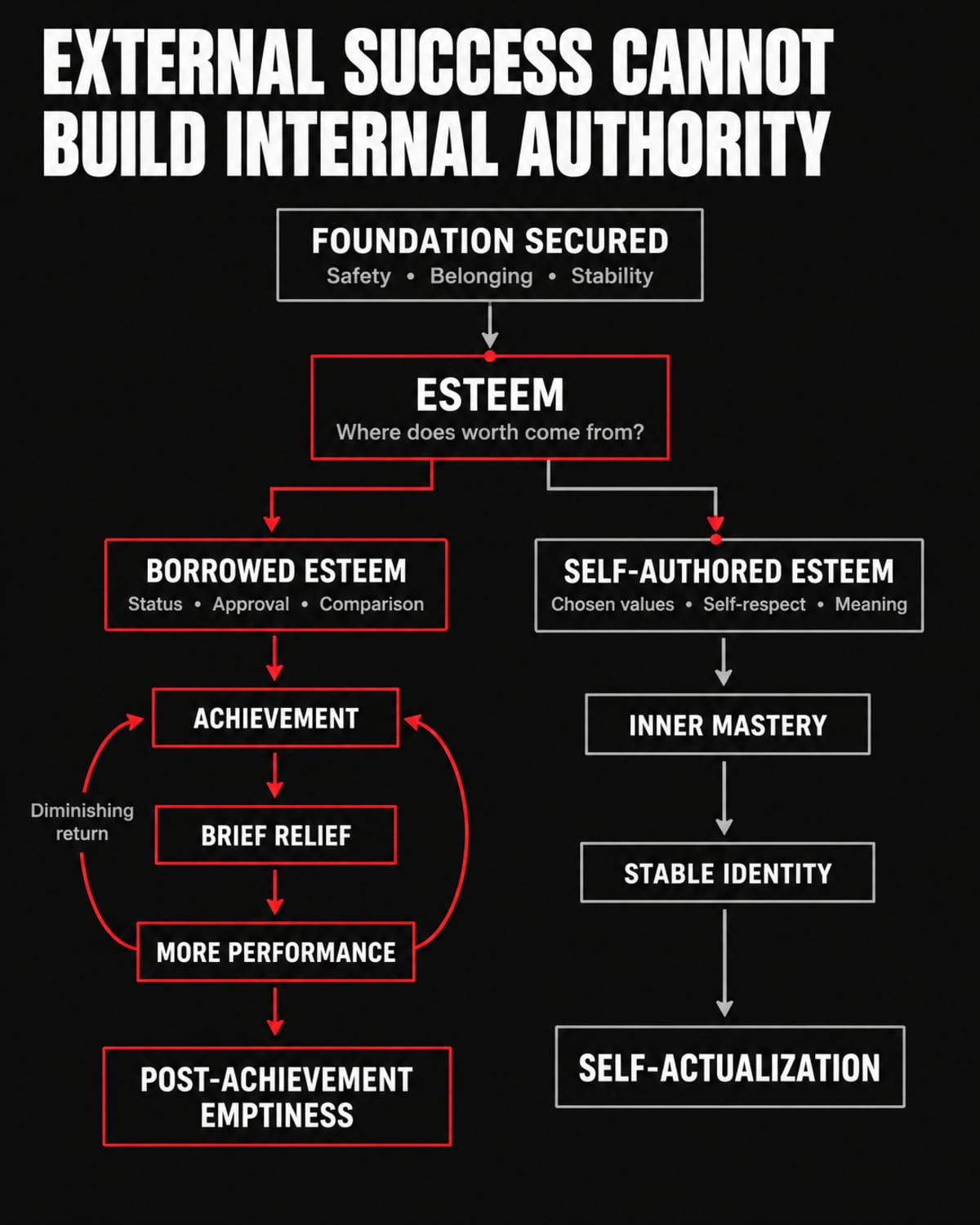
Here is what the self-help industry skips. Maslow's fourth level, esteem, splits into two very different fuels. There is esteem granted by others, and there is esteem generated from within.
Men raised on institutional programming run almost entirely on the first kind. Promotions, net worth, the respect of other men, the approval of a spouse. External validation becomes the engine, and the engine works for decades.
Then it stops working.
Researchers studying this transition connect the midlife crisis directly to the esteem stage of Maslow's hierarchy. Once basic needs, safety, and belonging are handled, esteem takes precedence, and a man discovers he built his entire identity on validation he never controlled.
Carl Jung called the task of the second half of life individuation, a concept nearly identical to Maslow's self-actualisation. A man cannot individuate while he is still performing for an audience.
The data confirms how real this breaking point is. A 2022 study published in Economica found that people in their 40s and 50s in developed countries are twice as likely to be depressed as those under 25 or over 65, and roughly 75% of men report some form of midlife transition.
Suicide rates peak for men in their early 50s. This arrives right when the external scoreboard says they have won.
Why Achievement Organises a Life Without Giving It Meaning
High-functioning men learn early to convert discomfort into output. Anxiety becomes preparation. Loneliness becomes longer hours. Grief becomes a training plan or another project around the house.
Researchers on male emptiness describe this precisely: achievement can organise a life while leaving the deeper question of who you are completely unanswered. Discipline becomes a socially admired form of avoidance.
If a man has spent decades being rewarded for performance, he may never have had to ask what sits beneath the performance.
The cage that holds men over 40 was built from wins that never satisfied. Each promotion bought a few weeks of relief before the hollow feeling returned. Each purchase worked for a shorter window than the one before it.
Psychologists call the aftermath post-achievement emptiness: the flat, restless, numb feeling after reaching a goal you expected to feel satisfying. The goal functioned as a distraction from the real question the entire time.
Maslow would recognise this instantly. A man stuck in borrowed esteem can keep stacking trophies forever and never touch self-actualisation, because self-actualisation requires a self, and he outsourced the construction of his to institutions that never had his interests at heart.
The 3 Stages of a Man's Life, Mapped Onto the Pyramid
In our work, and in the framework laid out in the article on the three stages of a man's life, we track every man's journey through three distinct phases. Each phase corresponds to a section of Maslow's hierarchy.
Stage One: The Programmed Climb
From boyhood through roughly age 40, a man climbs the lower levels on autopilot. School, career, marriage, mortgage. He secures physiology, safety, and belonging exactly as instructed.
He believes the climb is his own idea. It was installed.
Stage Two: The Collapse
Somewhere between 40 and 55, with peak intensity around 45 to 50, the esteem engine fails. Divorce, burnout, health scares, or simple deadening numbness. The manufactured life cracks open.
We treat this stage as the doorway. Collapse reveals the distance between who a man pretends to be and who he actually is, and that revelation is the admission ticket to real work. Men transform through crisis. Comfort has never produced a single one of them.
Stage Three: Internal Authority
The third stage is Maslow's peak, reached on the man's own terms. Self-actualisation stops being a corporate buzzword and becomes a daily practice: living from internal meaning, detached from the approval of people who were never paying attention anyway.
This is the second-half life. Few men reach it because few men accept the toll at the door, which is the death of the performing self.
The 5M Method: Rebuilding the Hierarchy From the Inside
Understanding the diagnosis is step one. The re-imagined spin on our 5M method is how we rebuild each level of the pyramid with internal materials instead of institutional ones.
- Mindset. Perspective is the only variable that matters. Change how you see your situation, and everything downstream shifts. Every other intervention is secondary.
- Meaning. Replace borrowed goals with chosen ones. You decide what matters when nobody is watching and nobody is scoring.
- Mastery. Redirect the discipline you built for external rewards toward inner development. The work ethic stays. The audience leaves.
- Mortality. Live as if already dead. Detachment from outcomes, possessions, and approval is the fastest route to freedom we know, and it has to be practised, since reading about it changes nothing.
- Mission. Build something that outlasts you. Legacy work measured in generations, with income and status demoted to byproducts.
Notice what the 5M method refuses to include. There are no dating tactics, no wealth hacks, no performance optimisation. Those are external answers to an internal problem, and selling them to a man in stage two is malpractice.
What This Means for Your Quality of Life After 40
Quality of life, for a man in the second half, gets measured by one question: are you living from your own authority, or performing for a system that was rigged before you arrived?
Maslow gave us the map. Unravelling the masculine dilemma explains the detour. The three stages show you where you stand, and the 5M method gives you the route up the final level.
Here is where we suggest you start.
- Name your stage honestly. If the engine is sputtering, say so. Denial extends stage two for years.
- Audit your esteem sources. Write down the last five things that made you feel successful. Mark each one as internal or external. The ratio tells you everything.
- Stop grinding and sit still. The world tells men in crisis to work harder. Stillness, reflection, and honest self-examination rebuild a man from the inside out. Grinding rebuilds the cage and further clouds the water.
- Answer the deeper question. Underneath every tactic and every logistic sits one inquiry: why are you living this way? Sit with it until an honest answer surfaces.
This work is uncomfortable. It demands commitment before it gives relief, which is exactly why we require it of every man who walks through our dragon door.
The crisis you are in is the invitation you have been waiting for. Maslow drew the peak decades ago. The second half of your life is where you finally climb it as yourself.