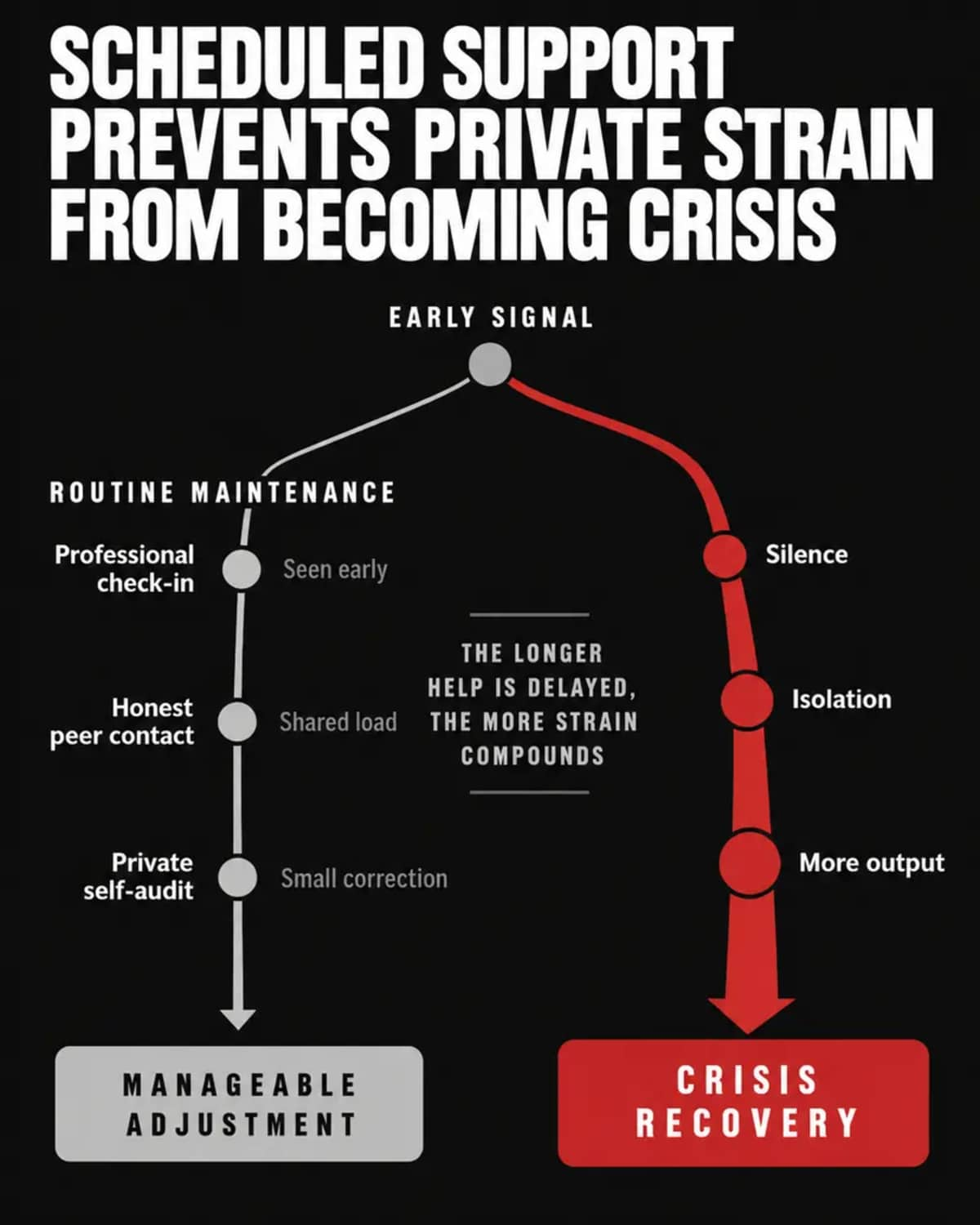
You check the oil in your truck every few thousand miles. You rotate the tyres. You replace the brake pads before they grind metal on metal. You do this because you understand a simple principle: small, scheduled attention prevents catastrophic failure.
Then you treat your inner life like it runs on borrowed time.
I know this move because I lived it. I ran hard for decades, converted every warning light into longer hours, and waited until the whole machine came apart before I asked a single honest question. The collapse taught me what the maintenance schedule would have taught me cheaper.
The numbers confirm what I lived. Nearly two-thirds of men say they hesitate to seek professional help for stress, anxiety, and depression, and many report they would only reach out after hitting the point of suicidal thoughts. A Cleveland Clinic survey found that 72 percent of men would rather do household chores than go to the doctor.
Sit with that. Men who would never skip an oil change will skip the checkup on the one system that runs everything else.
The Reluctance Was Installed, So Stop Blaming Your Character
The man who waits until collapse before telling anyone is executing code he never wrote.
The institutions that raised you taught one equation early: crisis equals failure. A man who struggles has lost the game. A man who asks for help has admitted he lost. So the trained response to inner trouble is silence, isolation, and more output.
Research backs this up. Studies show that internalised masculine norms directly predict lower help-seeking behaviour and higher self-stigma across cultures. The same programming that built your dilemma guards the exit.
This is commonly overlooked. Men treat their reluctance as a personal flaw, feel shame about the shame, and bury it deeper. Understanding that the reluctance was installed changes your relationship to it.
You stop defending the silence and start auditing it.
The cost of waiting is measured in bodies. Men account for nearly 80 percent of suicide deaths while accessing mental health services at roughly half the rate women do. The mortality risk for severely isolated men runs 75 percent higher than for socially connected men. Isolation is the engine of every quiet collapse I have witnessed, including my own.
Maintenance Beats Rescue, Every Time
Here is the reframe I hand the men who come to me in free fall.
Crisis is the expensive tuition. Maintenance is the cheap tuition. Both teach the same lesson, and you choose the price.
A maintenance approach to your inner life has three components. Each one requires you to subject yourself to scrutiny, which is exactly why men avoid them until the engine seizes.
1. See a Professional on a Schedule
Book a mental health checkup the way you book a physical. Quarterly works for many of the men I coach. Therapy at a regular cadence catches the symptom while it is still information instead of wreckage.
This is maintenance, and framing it as weakness is a leftover of the programming. The mechanic who inspects your brakes is in the prevention business. So is the professional who inspects your thinking.
2. Keep Up With Men Who Tell the Truth
Men need men. I have said this for years, and the research keeps agreeing with me. Studies on men's support groups show measurable benefits in peer support, reduced stigma, and resilience, particularly for men in isolation after major life events.
There is a structural reason this matters. Pew Research found that 74 percent of men turn first to a spouse or partner for help, while reaching out to friends far less often than women do. That builds a single point of failure into your support system. When that one connection strains or breaks, the man has no backup, and the strain on the marriage increases because it carries a load it was never designed to carry alone.
A men's group or two honest friends builds redundancy. Redundancy is what keeps a rough month from becoming a collapse.
3. Conduct Honest Self-Examination
Twenty minutes of stillness daily. A monthly audit of where your time actually went versus what you claim to value. Written answers to the question of why you are living this way.
This is the scrutiny men dodge hardest, because the examiner and the examined are the same person, and the findings have consequences.
The 5M Method, Mapped Onto Maslow
Maintenance only holds when it sits inside a structure. In Dragon coaching, we work five Ms in sequence: Motivation, Mindset, Movement, Momentum, Maintenance. Mapped against Maslow's hierarchy, the method becomes a route up the pyramid built with internal materials.
- Motivation sits at the base, where Maslow placed physiological and safety needs. Before anything else, you name the installed programming and face the fear underneath it. Fear is the cage men mistake for safety. Until you examine it, every effort above it rests on sand.
- Mindset corresponds to belonging. Once you know what actually drives you, you rebuild how you see your relationships. You stop performing for an audience and start connecting as yourself. This is where the men's group and the honest friendships live.
- Movement maps to the esteem level, with one critical correction. Maslow's esteem stage splits into esteem granted by others and esteem generated from within. Action taken for applause rebuilds the old cage. Action taken from internal authority builds the second life.
- Momentum is the approach to self-actualisation. Aligned motivation, mindset, and movement compound naturally over time. Forcing it fails. Creating the conditions for it works.
- Maintenance holds the peak. Self-actualisation is a daily practice rather than a trophy. The scheduled therapy, the standing meeting with your men, the regular self-audit. Without the fifth M, the whole climb reverts within a year.
Notice where Maintenance sits in the sequence. It comes last in the build and then runs forever. Men who treat transformation as an event instead of a practice slide back to the old operating system. The fifth M is what makes the other four permanent.
Scrutiny Is the Toll at the Door
Every piece of this requires you to be seen. By a professional. By other men. By yourself, in writing, without the performance.
That exposure is the price, and I will level with you about it. The first sessions are uncomfortable. The first men's group meeting feels like standing in your underwear. The first honest time audit embarrasses you.
The discomfort is the mask loosening.
You have spent decades building tolerance for physical discomfort. Early alarms, hard training, long hours. Point that same tolerance at the scrutiny. The man who can sit through a brutal quarter at work can sit through an honest hour with a therapist.
I live on the other side of this now. I own almost nothing, perform for no one, and maintain my interior the way I once maintained my image. The maintenance costs me a few hours a week. The collapse cost me years.
Your Assignment This Week
Reading changes nothing. Here is the practice.
- Book one appointment with a professional. Call today. Treat it as a diagnostic, the same way you would treat a strange noise in the engine.
- Contact one honest man. A friend, a group, a mentor. One trusted man in your corner changes the math. Ask him to meet monthly and tell him why.
- Run a thirty-day time audit. Count the hours that served your stated values. Count the hours that served someone else's instructions. Write both numbers down.
- Start the first M. Write one page on what you were programmed to want and what you actually want. The distance between those two answers is where your work begins.
You maintain your truck because you understand what failure costs. Your inner life runs on the same physics.
Schedule the maintenance before the engine forces the conversation. The crisis will still teach you if you wait. It will just charge you everything you have.
Do your work. Pay your price. Get it done.