I have been a consciousness and intellect snob my entire life.
I required the people around me to know what they do and to have solid reasons for their behaviour. No exceptions for family. No exceptions for old friends. No exceptions for people who meant well.
Years ago, my brother sat me down and warned me. He said that if I kept being strict, rough, and unexcusing of unconscious behaviour, nobody would want to be around me. My style would drive friends away, and I would end up alone.
I told him the only people I want around me get my style and want me to be exactly like this.
Decades later, I can report the results. He was half right. The crowd thinned. And the men who stayed were worth more than the hundred who left.
The Warning Rested on a False Assumption
My brother assumed that a wide circle equals a rich life. He inherited that assumption the same way men over 40 inherited their definitions of success: without examination.
I rejected it early, on instinct. The research caught up later.
Researchers from the London School of Economics and Singapore Management University analyzed data from 15,000 adults and found that individuals with higher intelligence reported greater life satisfaction when they spent less time socializing. They preferred fewer, deeper connections and felt less satisfied when they socialized frequently.
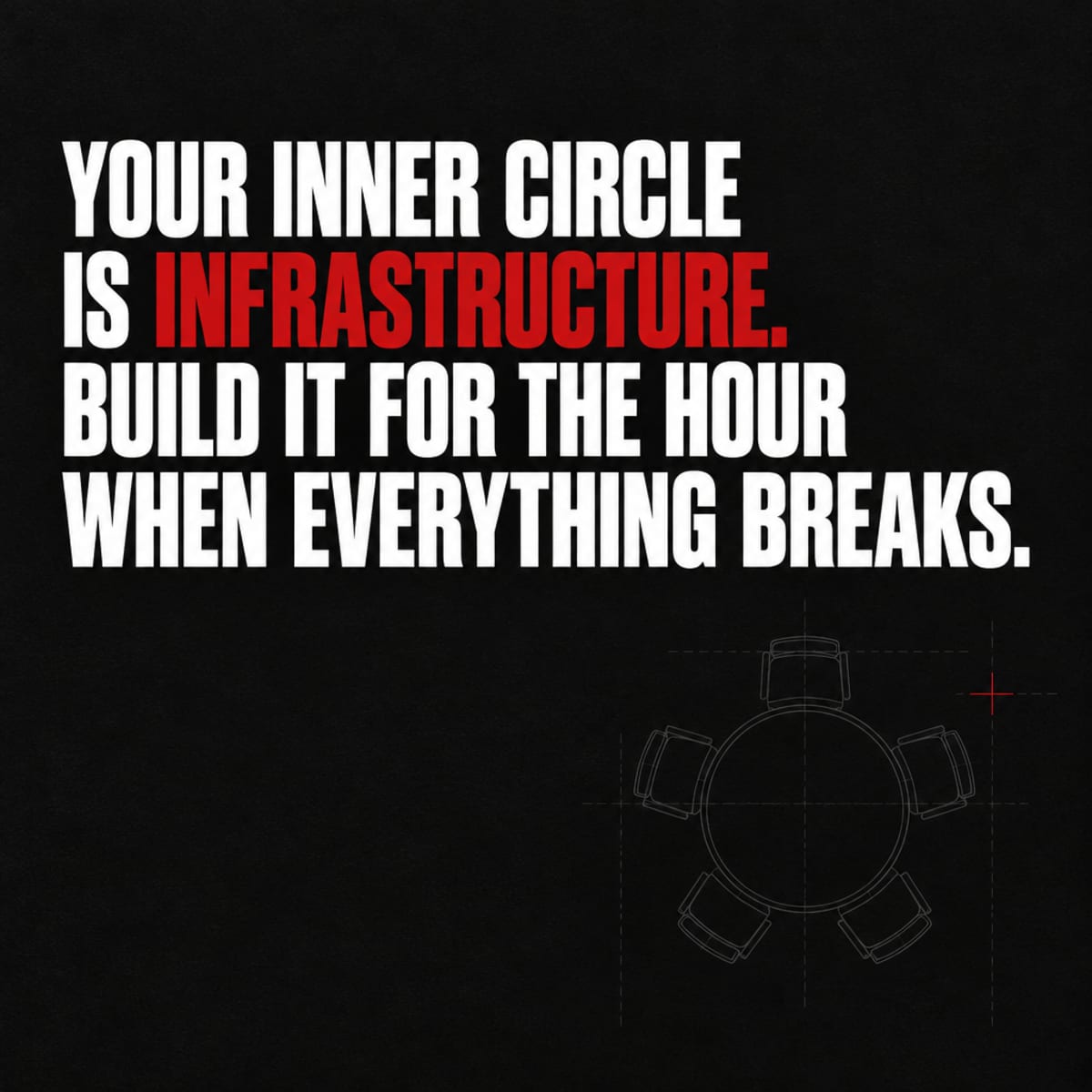
Anthropologist Robin Dunbar put a number on the inner circle: five people. Your brain maintains roughly five stable, deep relationships. Everything beyond that runs on reduced bandwidth.
So when I filtered hard, I was protecting five seats. Anyone who fills those seats with unconscious people has spent their entire relational budget on noise.
My selectivity was infrastructure. It looked like harshness from the outside. From the inside, it was the only rational allocation of a scarce resource.
Unconscious People Are Dangerous, and I Mean That Literally
Here is the part of my position that offends people, so I will state it plainly.
A person who does not know their own triggers is a hazard. They operate on autopilot. They react instead of respond. In a calm season, they seem pleasant enough. Under pressure, when you actually need a friend, their unexamined wiring takes the wheel.
You cannot predict them. You cannot reason with a reaction. You can only absorb the damage.
I watched this play out across three marriages, across wealth gained and lost, across every collapse I rebuilt from. The people who hurt me worst were rarely malicious. They were unconscious. They had never asked themselves why they do what they do, so they could not stop doing it.
Insight is a safety requirement in my world. A man who has examined his fear, named his programming, and taken responsibility for his reactions is safe to build with. A man who has done none of that work will eventually detonate near you, and he will call it your fault. I guess you can call that being mean, but I just call it the way it is.
💡 Run this test on your own circle: ask each person in it to explain the reason behind one of their recurring behaviours. The ones who can answer belong in your five. The ones who get defensive just told you everything.
What I Actually Required: Deliberate Rumination
My standard was never credentials or raw IQ. I have met wealthy, asset-rich, brilliant men who were completely asleep. The requirement was always the same: solid reasons for your behaviour, held consciously, available for inspection.
Psychology has a name for this. Researchers studying people who grow from painful experiences found the differentiator was deliberate rumination. The people who grew spent serious time making sense of what happened to them, reflecting on how the events changed them, and converting that reflection into changed lives.
That is the entry fee for my friendship. You take your experience, you sit with it, you extract the lesson, you adjust your conduct. Then you can sit at my table, because now we can actually talk.
Everything else is dragon food.
Intentional Adversity Training as a Friendship Filter
Beyond insight, I required one more thing: a dedication to growth through adversity. Chosen adversity. Trained adversity.
The men I keep close do hard things on purpose. They put themselves in situations that expose their weaknesses, and they stay long enough to build capability. Researchers studying antifragility describe exactly this: stressors intentionally engaged to strengthen capabilities, adversity used as training material instead of merely survived.
Jensen Huang, the CEO of NVIDIA, told a graduating class something that sounds brutal and is simply true:
"Unfortunately, resilience matters in success. I don't know how to teach it to you, except I hope suffering happens to you."
A friend who structures his life to avoid discomfort will fold when your life collapses, because he has never practiced standing in collapse. A friend who trains against adversity has calibrated himself. He knows his limits because he has visited them. He is useful at 2 a.m. when your marriage ends or your company dies.
I have needed friends at 2 a.m. more than once. I built my circle for that hour, years in advance. My brother built his circle for barbecues and mutual admiration.
What the Filter Produced
Here is what happened as I held the line over decades.
- The wrong people self-selected out. No confrontation required. Men allergic to accountability found my presence uncomfortable and drifted away on their own.
- The right people self-selected in. Men committed to conscious living recognised the standard and moved toward it. They wanted a friend who refused to flatter their excuses.
- Every remaining relationship could carry weight. When I lost everything, the men still standing next to me were builders. They had trained for rubble. Several of them had rebuilt from their own.
Choosing friends works as an active, conscious process. The research on growth-oriented relationships recommends seeking people who sharpen you, who challenge your thinking constructively, rooted in respect. I ran that process before I had language for it. The language came later. The results came first.
The Objection I Take Seriously
I want to be honest about the cost, because men over 40 reading this will test the idea against their own lives, as they should.
There were lonely years. Filtering hard means long stretches with empty seats at the table. If you need constant company, this path will hurt before it pays.
There is also a trap inside the philosophy. Standards can become armour. A man can use "I only accept conscious people" to avoid ever being known, which turns a legitimate filter into sophisticated hiding. I had to check myself for this repeatedly. The test is simple: your standard is healthy if the people who pass it get full access to you, including the unfinished parts. If nobody ever passes, the standard stopped being a filter and became a wall.
So hold the line, and audit the line.
Build Your Table for the Second Half
If you are past 40 and recognise yourself in this, the application is direct.
Stop apologizing for your standards. The exhaustion you feel around unconscious people is accurate information about incompatibility at the level where friendship actually operates.
You have roughly five seats. Fill them with people who know why they do what they do, who train against adversity on purpose, and who want you sharp instead of comfortable.
My brother predicted I would end up alone. Instead I ended up with exactly the men I asked for, and nobody else.
That was the design the whole time.