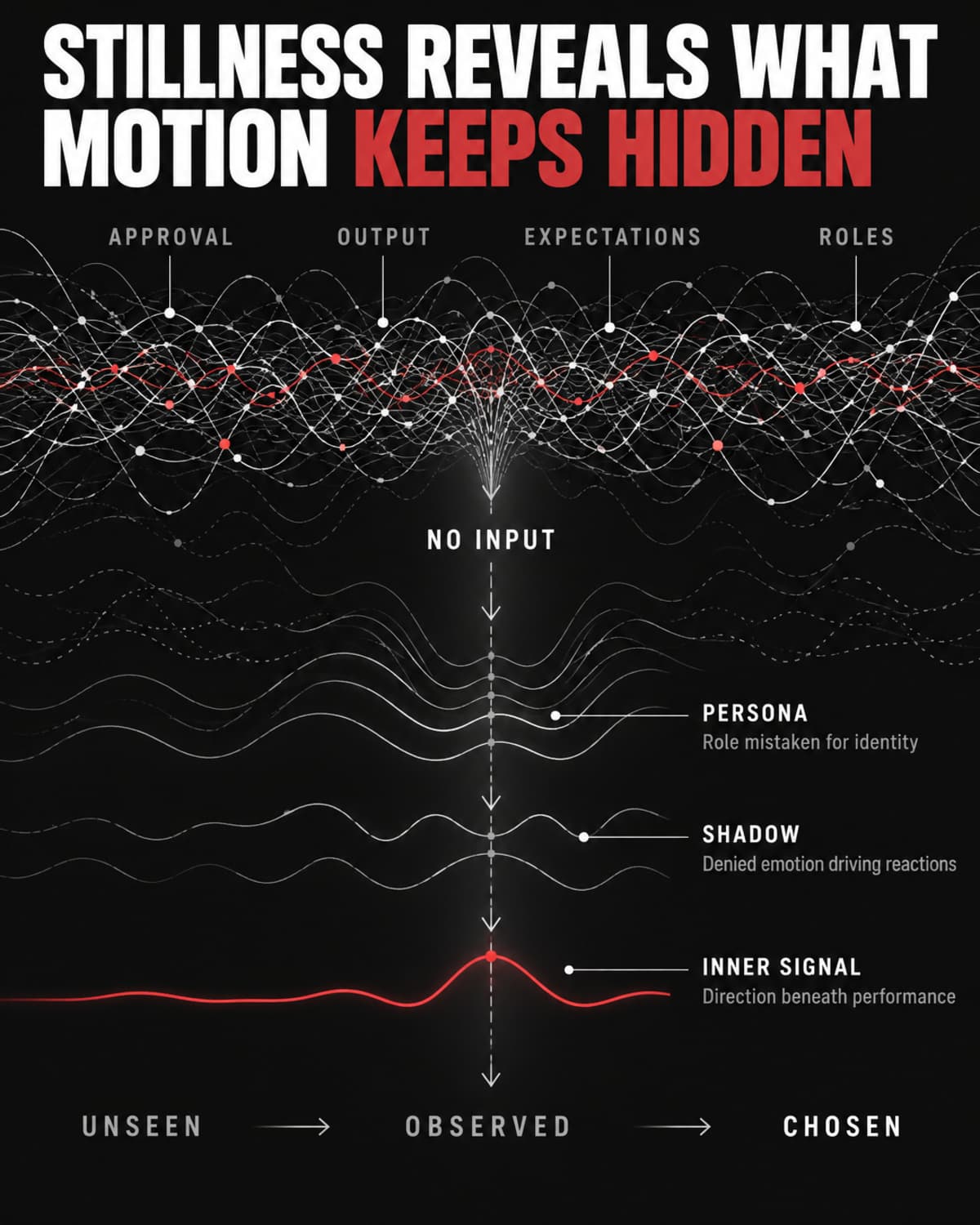
Before anything in your life changes, you have to stop.
I mean that literally. Stop moving, stop producing, stop performing. Sit in a chair with no phone, no agenda, and no audience, and watch what happens inside you.
For high-performing men over 40, this is the hardest assignment I give. Harder than any business problem they ever solved. Because the moment a man stops, he meets everything he has been outrunning since he was a boy.
This article is the first in a series. I want to hand you a map of your own interior, built on the work of Carl Jung, because Jung drew the most accurate picture of the psyche I have found in decades of living, collapsing, and rebuilding. You can read every strategy book on the shelf and stay lost. A man with an accurate map of his inner world finds his way out.
The work starts with one skill: inner observation. The willingness to slow down long enough to tell the difference between what is real and what the outside world sold you.
You Have Been Running on Installed Software
The programming started before you could consent to it. School graded you on compliance. Work graded you on output. Culture graded you on the 3P script: protect, provide, procreate.
You absorbed all of it the way a goldfish absorbs water. Invisibly. Completely.
So by 40 or 45, you are executing code you never wrote. The career, the house, the image you maintain at dinner parties. Each piece arrived as an instruction, and you followed it because following it earned approval.
Then the approval stops working. The promotion lands and the satisfaction lasts a weekend. You wake at 3 a.m. with a clenched jaw and a feeling you can't name.
That feeling is information. Your inner world is trying to get a message through, and the only way to receive it is to stop and observe.
Jung gave us the vocabulary for what you'll find when you do.
The Four Structures Jung Mapped
Jung divided the psyche into distinct structures. Four of them matter most for this work: the Persona, the Shadow, the Ego-Self Axis, and the Self. Learn these four, and you can diagnose your own condition with precision.
The Persona: The Mask You Mistook for a Face
Jung described the Persona as a kind of mask, designed to make an impression on others while concealing the true nature of the individual.
Every man needs a Persona. You need one to run a meeting, raise kids, and function in society. The mask is a tool.
The trouble begins when you fuse with it. When "regional VP" or "provider" stops being a role you play and becomes the entire answer to the question of who you are. Jung observed that this overidentification with the Persona frequently becomes the catalyst for the midlife crisis.
The fused man is an empty shell. He performs competence all day and feels nothing by evening. His mask has eaten his face.
Inner observation is how you peel the two apart. Sit still and ask: who am I when nobody is watching, and nothing is being scored. If the question produces panic, you have found the fusion. That panic is diagnostic, and it is the beginning of the work.
The Shadow: Everything You Buried Is Still Alive
The Shadow holds everything your conscious mind refused to claim. The grief you converted into longer hours. The anger you were told good men don't feel. The vulnerability you learned to hide by age ten.
Here is the mechanism that matters. What you refuse to acknowledge does not disappear. It controls you from the shadows, surfacing as projection, self-sabotage, and repetitive behaviours you can't explain.
In my framework, I call these the dirty water symptoms. The jaw clenching, teeth grinding. The passive-aggressive comment to your wife. The contempt you feel for a certain type of man, which is usually contempt for a buried part of yourself.
What you deny becomes your master. What you confront becomes your resource.
Jung's process for working with the Shadow runs through five stages: recognition, acceptance, dialogue, integration, and embodiment. Notice where it starts. Recognition. You cannot integrate what you have never observed.
This is why stillness comes first. The Shadow only shows itself to a man who stops long enough to look.
The Ego-Self Axis: The Line That Got Cut
This structure is the least known and the most important for men in crisis.
Your Ego is your conscious identity, the "I" reading this sentence. The Self is something deeper: the core of wholeness and truth beneath all the roles. The Ego-Self Axis is the connecting link between them, and when that connection is injured, a man experiences alienation, a loss of belonging, and a collapse of meaning.
Institutional life severs this axis systematically. Every year you spend optimising for external metrics, the line to your interior frays a little more. Eventually the Ego runs on autopilot with no internal guidance at all. I call this state rudderless autopilot, and it produces a low-grade existential dread that no achievement touches.
Jung taught that the second half of life calls for reunion along this axis. The first half built your Ego. The second half requires the Ego to enter into service of the Self.
Repairing the axis comes down to attention. I give men a specific target: the 51/49 rule. Direct at least 51 percent of your attention inward, toward your own authority, and at most 49 percent outward, toward the demands and opinions of the world. The ratio matters. Sovereignty requires a clear internal majority.
The Self: What Was There Before the Programming
Underneath the mask, beneath the buried material, at the far end of the repaired axis, sits the Self. Jung considered it the organizing center of the whole psyche and the source of the Ego's energy and direction. This is the direction we call Return to Centre.
The Self carries your inherent value, the worth that exists independent of performance, income, or anyone's approval. The institutional world trained you to chase perceived value instead, worth assigned by a market of other people's opinions. That market never closes and never pays out.
Contact with the Self ends that transaction. A man anchored there still works, still provides, still shows up. He does it from choice instead of fear, and the difference changes everything downstream.
Why Stopping Is the Whole Method
None of these four structures become visible at speed. The grind is how the programming protects itself. A man in constant motion never audits the motion.
The science supports what contemplatives have practised for centuries. Regular silent meditation produces structural changes in brain regions tied to memory, emotional regulation, and stress management. Stillness lowers cortisol and sharpens decision-making. Your biology rewards the stop.
More importantly, stillness creates space for deep listening. The voice of the Self, collectively delivered as Intuition, Insight, and Imagination, is quiet. The noise of the Persona is loud. Only one of them survives when you turn the volume down, and it is the one that was telling the truth all along.
A Starting Practice for This Week
Theory changes nothing. Here is the practice.
- Sit for twenty minutes daily with no input. No phone, no music, no journaling at first. Just observe what rises. Discomfort counts as data.
- Catalogue your masks. Write down every role you perform in a week. Next to each one, note what you hide to perform it. The second column is a Shadow inventory.
- Track your attention ratio. At the end of each day, estimate how much of your attention went to managing external impressions versus consulting your own interior. Most men who do this honestly land near 95/5. The 51/49 target tells you how far you have to travel.
- Watch your strong reactions. Whatever triggers disproportionate contempt or envy in other men points at buried material in you. Write it down without fixing it.
This practice is uncomfortable by design. The discomfort is the mask loosening.
The Crisis You're In Is the Invitation
There comes a point, often at midlife, when the adapted personality stops being sufficient. The Persona cracks. The Shadow knocks. Jung called the process that follows individuation, the lifelong work of becoming who you actually are.
If your life is cracking right now, I want you to read that crack correctly. The collapse is showing you which parts of your life were real and which parts were costume. That revelation is worth more than everything the costume ever earned you.
I have lost the money, the marriages, and the image, more than once. Observation is the skill that let me rebuild from something true instead of rebuilding the cage with better materials.
Stop. Sit. Watch. The water clears when you quit stirring it.
In the next article in this series, I will take you deeper into the Shadow itself: how to recognise your specific buried material and begin the dialogue Jung prescribed. Until then, start the twenty minutes. The map only helps a man who is standing still enough to read it.