The headlines read like a diagnosis now. Global growth cut to 2.5%. Public debt heading past 100% of GDP. Energy shocks cascading through supply chains while inflation climbs in every economy that touches yours. War reigniting. Institutions failing in plain sight.
You can call it bad luck, bad policy, or a bad decade.
I call it water receding. And when the water recedes, you see who built on sand.
The worse things get out there, the more clearly one thing shows up in here: how much of your steadiness was borrowed from conditions you never controlled. The job market held you up. The portfolio held you up. The title, the routine, the approval of people who were busy performing their own survival. As those supports crack, the question you have been outrunning since your twenties finally catches you.
Is this all there is.
Every man I work with arrives at that question. The lucky ones arrive before the crisis forces it. This article is about what to do when it arrives at your door, because it is arriving at everyone's door now, and the old covers have stopped working.
The Signs Are Not Subtle Anymore
For decades, a man could hide an internal vacancy behind a functioning life. The economy cooperated. The culture rewarded the mask. Busyness looked like purpose, and the checks kept clearing.
That arrangement is ending in front of you.
Look at the numbers underneath the noise. In 2025, 66% of U.S. employees reported burnout, an all-time high. Men account for nearly 80% of suicide deaths in the U.S., and 40% of men have never spoken to anyone about their mental health. Fifteen percent of men now report having no close friends, a fivefold increase since 1990.
Those are not economic statistics. Those are the receipts of a way of living that was always going to fail, finally failing at scale.
The engineered systems you were told to trust, the economy, the schools, the career ladder, the story about what a man is for, are producing visible breakdowns at the same time. Economy. Technology. Gender. Education. War. The failures stopped being abstract. They are landing in your house, your marriage, your bank account, your son's bedroom.
Collapse has come home. Willful blindness was a strategy that required a stable backdrop. The backdrop is gone.
The Pressure Is Coming From the People Closest to You
Here is the part that stings. You will not get to time this reckoning on your own schedule.
The women in your life are done waiting for you to notice yourself. The younger generations are watching how you handle this, and they are drawing conclusions. A wife who has spent twenty years married to a role instead of a person eventually stops negotiating with the role. A son who inherits your silence inherits your fate.
Research on masculinity describes exactly what they are reacting to. Many men have supplanted meaning with masculinity, living in a hypervigilant state of compensating for any violation of the code, which produces anxiety, depression, and isolation instead of the belonging it promised.
Eighty-two percent of men say society still expects them to be the primary earner, an identity anchor so deep that losing it triggers a full identity crisis. You feel that pressure as duty. The people around you increasingly see it as a man hiding inside a function.
They will force the issue. Through divorce papers, through estrangement, through the quiet withdrawal of respect. You can meet the moment voluntarily or you can be dragged into it. Those are the two options left.
The Panic You Feel Was Installed Before You Were Born
When the external supports start failing, you feel something that confuses you. A fear far bigger than the actual situation warrants. A teeth-grinding desperation that spikes at 3 a.m. over problems you could rationally handle.
That response has a lineage.
Transgenerational trauma is documented science now. Sons of Civil War prisoners carried shortened life spans. Epigenetic studies show that extreme stress in males alters brain, behavior, and sperm in the next generation, with fear responses persisting two generations down the line. Your grandfather's war, your father's layoffs, the depression-era scarcity nobody ever processed, all of it rides in your nervous system as standing orders.
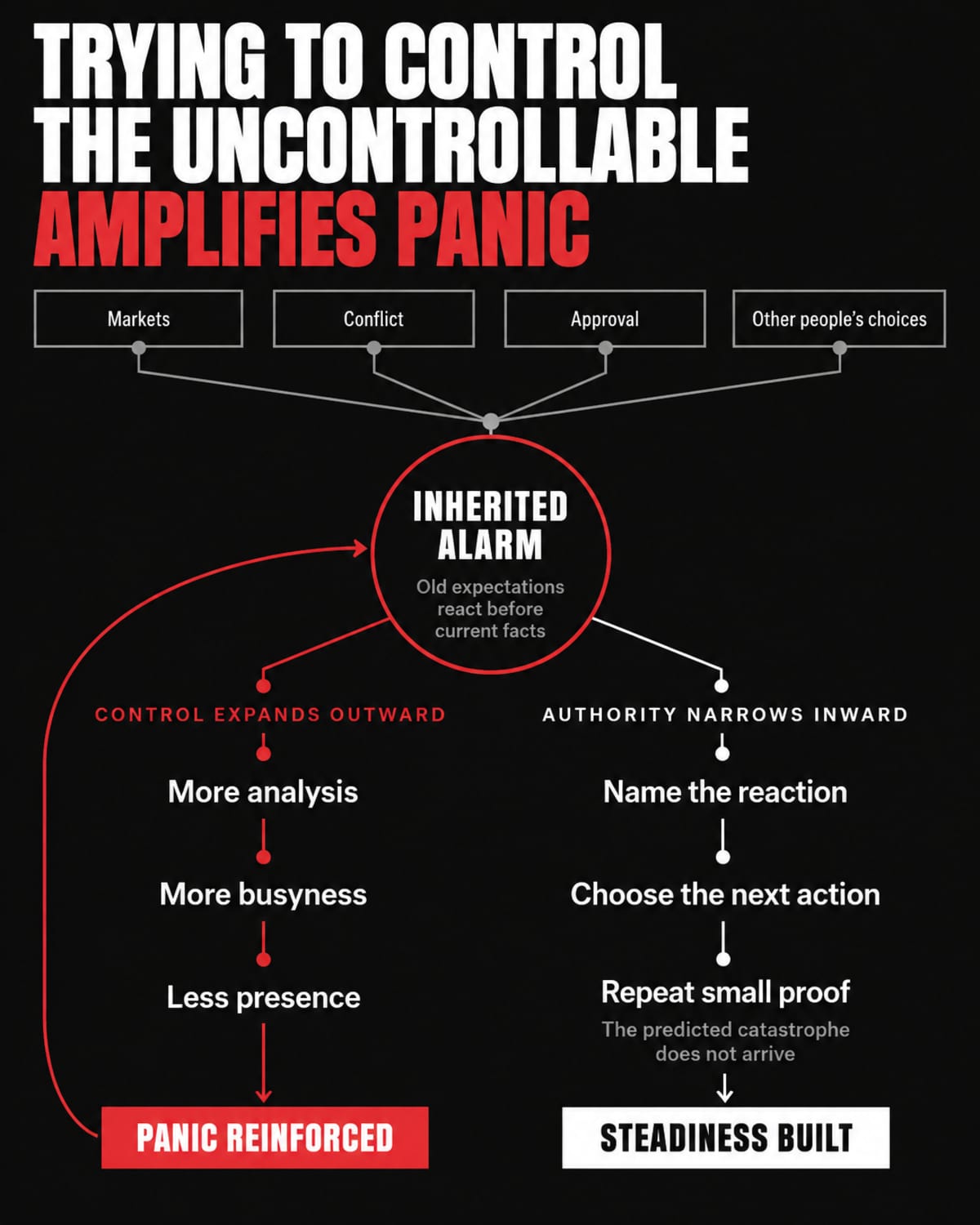
Your brain spends much of its time reacting to what it learned to expect, long before it reacts to what is actually in front of you.
This is why global turmoil hits you harder than the facts justify. The headlines are triggering a program written by men who faced famine, war, and ruin, and who passed the alarm down without the manual. You inherited the panic without the context.
Seeing this clearly removes the shame. The fear is real, and the fear is also not yours. It arrived before you did. What is yours is the decision about whether it keeps running your life.
Overthinking, Busyness, and Complexity Are Costumes
I want to state my position plainly, because it offends people who profit from the opposite.
The racing mind is a hiding place. The packed calendar is a hiding place. The elaborate plans, the endless research, the sophisticated analysis of your own situation, all of it serves one function: it keeps you moving fast enough that you never have to sit with what stillness would reveal.
The men who slow down long enough to look find predictable things underneath. Loneliness inside a marriage. Envy of other men. Shame about choices made for approval. A boy who concluded decades ago that he had to earn permission to exist.
The costume carries a brutal price tag. Your boss calls your overwork commitment. Your family calls it providing. Your body calls it chronic cortisol, and your relationships call it absence. The grind fails even on its own terms. A Stanford study found that people working over 50 hours a week are 34% less productive than those working 40. You are trading your health and your presence for output you are not even producing.
Complexity feels like intelligence. In a man avoiding himself, it functions as camouflage.
Use the Book as a Wake-Up Mechanism
I wrote Unravelling the Masculine Dilemma for exactly this moment, when the outer collapse makes the inner collapse impossible to ignore. I did not write it to motivate you. Motivation burns off by Tuesday. I wrote it to interrupt the program so thoroughly that you can no longer unsee it.
The work to clean your dirty water rests on three moves. Each one happens in writing, between you and the page.
1. Name the Program
Step back from your automatic reactions and examine them as an observer. When the panic spikes, write down what happened, what meaning you assigned to it, what you were trying to control, and what you fear it says about you.
Then go one layer deeper. Trace the fear backward. Find the first time you felt it, and identify whose approval you were chasing when it formed. The answers arrive as memories and body sensations. Write them all down.
A named program loses its disguise as personality.
2. Separate What You Govern From What You Cannot
Panic survival mode is the attempt to control the uncontrollable. Markets, elections, wars, other people's opinions, your children's choices. The global situation makes this attempt more obviously futile than it has ever been, which is a strange kind of gift.
You govern three things:
- The integrity of your next action
- The standards you practice daily
- Whether you tell yourself the truth
Everything outside those three is weather. The moment you narrow your attention to what is actually yours, your nervous system receives its first real evidence that it can stand down. Grant yourself permission to rest, deliberately, in your calendar, in ink. Almost no man grants it to himself unprompted.
3. Act Small, Repeatedly
Dramatic transformation is another performance. Real rewiring happens through unglamorous repetition.
Take an evening off without earning it. Tell one trusted man the truth before a crisis forces it out of you. Write one honest sentence each morning. I am afraid about money beats a paragraph of sophisticated noise every time.
Each small act teaches the inherited program that the predicted catastrophe does not arrive. Complexity dissolves one boring, honest, repeated choice at a time.
The Invitation Inside the Wreckage
I have lived both sides of this. Wealthy and broke. Married and alone in the rubble, three times over. Today I own close to nothing, pick up trash on my street, and sleep better than I ever did in the big house. I offer that as data, from a man with nothing left to prove to you.
Here is my conclusion: the dirty water that suffocates and kills is real.
The world's engineered failures are doing you a favor you never asked for. They are stripping away the covers before your private collapse could finish the job quietly. The panic you feel is inherited. The busyness is a costume. Underneath both sits a man with internal authority he has never once used, because nobody told him it was there.
The crisis arriving at your door is the invitation you have been waiting for, dressed in clothes you did not expect.
Read the book as a mirror. Do the written work it demands. Confront the fear your father handed you so your son inherits something better. The second half of your life starts the day you stop performing for an audience that was never watching and start governing the only territory that was ever truly yours.
Start today. Read the book, take the inventory, and write the first honest sentence.