In 1954, psychologist Leon Festinger published his social comparison theory. His claim was simple and uncomfortable: comparing yourself to other people is a basic human need, wired in, running whether you consent to it or not.
I read that research as a man who spent the first half of his life obeying it blindly.
Festinger gave the mechanism a name. I give it a different one when I work with men over 40: the masculine dilemma. Society wrote the rules of the comparison game, handed you a scoreboard at birth, and never asked whether you wanted to play.
You answer to that scoreboard every day. The question I want to put in front of you is who authorised it.
Festinger Predicted Your Phone
Festinger worked decades before social media existed. When researchers tested his theory against the digital age starting around 2014, the predictions held. The theory extended cleanly into a domain he never imagined, and the comparison economy went from your neighbourhood to the entire planet.
That matters for one specific reason. The burden men carry today is the same burden Festinger described, amplified to industrial scale.
Your father compared himself to the men on his street. You compare yourself to a curated feed of every man alive.
Here is what I established through my own collapse at 31, through losing a fortune, ruining my reputation, losing my status, and rebuilding, through three marriages and years of silence in a desert hovel: the comparison is the cage. The content of the comparison, money, status, physique, follower counts, is interchangeable. The structure is what imprisons you.
The Bill Arrives in Midlife
The data on this is blunt. In a national survey of nearly 9,000 people, 56.4% reported pressure to conform to masculine norms, and that pressure correlated with higher odds of depression and anxiety.
The provider mandate alone tells the story. Research shows 86% of men view being a provider as defining manhood, and men under financial strain were 16 times more likely to report suicidal thoughts than men who were not.
Sixteen times. That number stopped me when I first read it, because I recognise the men behind it. They sit across from me in crisis.
53% of men say "no one really knows me." 57% feel no one cares if they are okay. The male suicide rate runs roughly four times higher than the female rate.
Those figures describe the Institutionalised Man at the end of his program. He performed every rule, protected, provided, competed, and the scoreboard paid him in isolation.
The men who call me at 40, 50, 55 built the house, held the title, raised the kids. The achievement worked exactly as advertised and left them empty exactly on schedule. The social pressure Festinger described has been quietly collecting interest for four decades, and midlife is when the bill arrives.
Rule #1: Boundaries Define Your Inner Domain
When a man asks me where to start, I give him one rule before any other.
Set boundaries. Let people know what is allowable and what is available, according to your own inner domain.
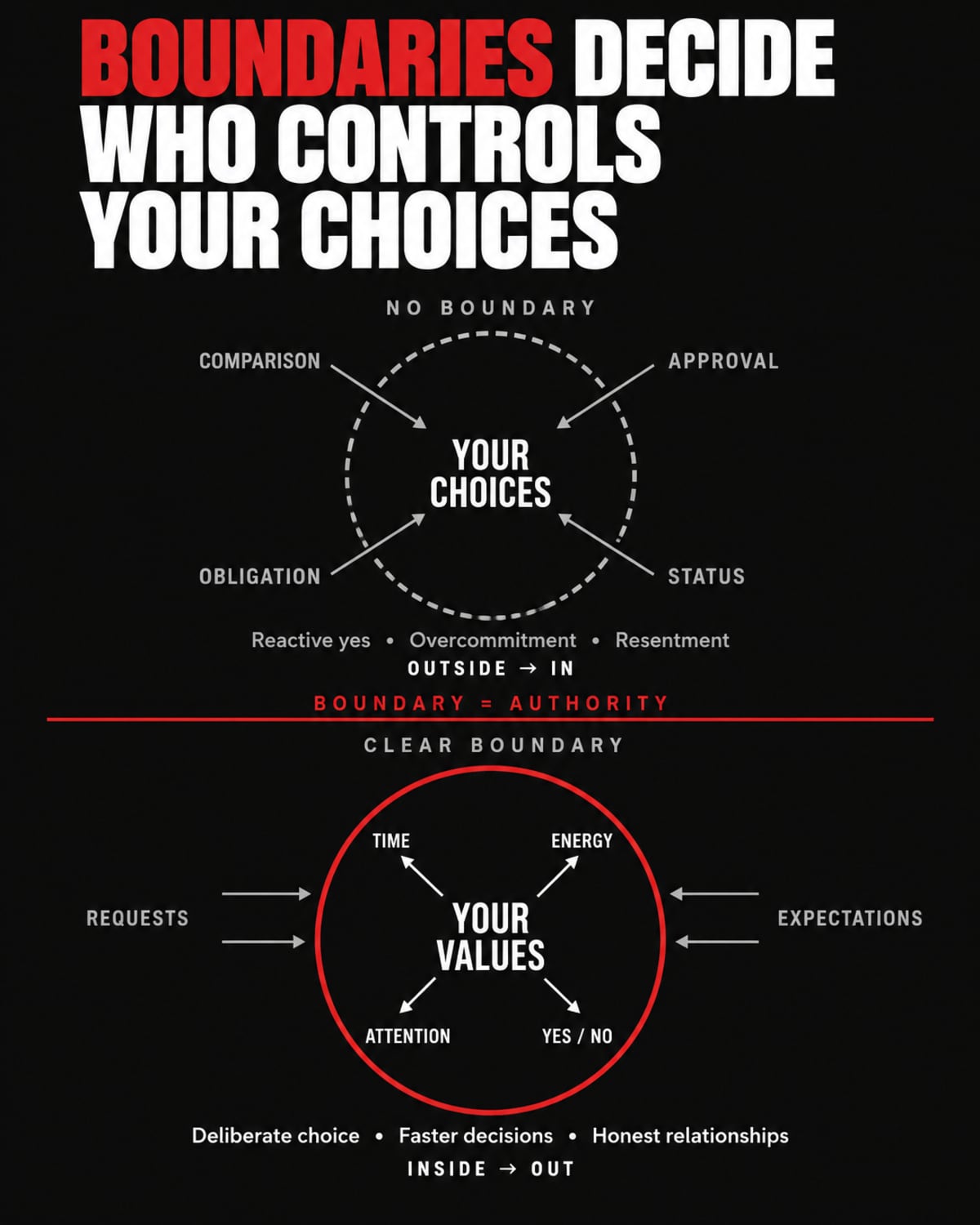
I want to be precise about what a boundary is, because the word gets softened into uselessness. A boundary is a declaration of jurisdiction. It says: this territory, my time, my attention, my energy, my yes and my no, is governed from the inside. Your approval does not hold office here.
The comparison economy survives on obligated men who never made that declaration. A man who obligates himself without boundaries runs on open access. Every request, every expectation, every unspoken obligation walks in and bills him. He says yes out of guilt, overcommits out of habit, and the resentment builds in the space between his actions and his actual values.
The research on this is consistent. People who set clear personal boundaries report lower anxiety, lower depression, and lower stress. Clear limits create a sense of safety and control, and the overwhelm of other people's demands drops.
For men over 40 specifically, boundaries carry an extra function. Cultural programming trained you to be endlessly available, the tough one, the go-to guy. Every boundary you set is a direct repudiation of that programming. It is the first act of the Authentic Man.
What a Real Boundary Sounds Like
Concrete, so there is no hiding in abstraction:
- "I finish work at six. Calls after that wait until morning."
- "I will help you move once. I will stop rescuing you from the same decision every year."
- "Saturday mornings belong to my own reflection. I am unavailable."
- "I no longer discuss my worth in terms of what I earn."
Each one costs you something socially. Each one returns something larger internally. That trade is the whole practice.
Agency Is the Muscle Boundaries Build
Here is why boundaries come first, and everything else follows.
Agency is the ability to act in your environment and influence it. Research on mastery across the life course shows that agency promotes health from early adulthood into midlife. Men with an internal locus of control believe outcomes depend on their own effort, and they apply that effort where it counts.
Now look closer, because the research contains a trap worth investigating. Studies show men report a higher sense of agency than women, a broader horizon of possibilities. Society expects men to be active, dynamic, persistent. That expectation sounds like power.
It functions as a leash of internal blindness that is the basis of our collective masculine dilemma.
Agency defined by external expectation is performance wearing the costume of freedom. The man grinding eighty hours to satisfy the provider mandate feels agentic while executing someone else's instructions. His choices are pre-approved by the comparison economy before he makes them.
Real agency begins where the boundary ends. Inside the territory you have claimed, your choices answer to your own values. That is where inner capacity grows. For men carrying old wounds, this is the specific medicine: trauma left you powerless, and boundaries return agency and control. Each boundary held is a repetition. The muscle grows the way all muscle grows, under load, over time.
Men who commit to this report the same progression. They become less reactive. Decisions speed up. The honest relationships deepen, and the performative ones fall away on their own, which is painful for a season and clarifying for a lifetime.
The Practice, This Week
Reading changes nothing. Here is the assignment.
One: write your jurisdiction. List what is allowable and what is available in your life, time, energy, conversation topics, favours, access. One page. Your inner domain, in ink.
Two: find the leak. Identify the single place where comparison or obligation drains you most. The relative who treats you as an ATM. The wife who expects you to run with every panic. The feed you check before your feet hit the floor. The yes you give to avoid a hard conversation.
Three: set one boundary there. Out loud, to the person involved, this week. Expect pushback. The people who benefited from your open borders will protest the checkpoint. Their protest confirms the boundary was needed.
Four: hold it for thirty days. A boundary announced once and abandoned teaches people you negotiate. A boundary held teaches them who governs your domain. It teaches you the same thing, which is the actual point.
You Were Programmed. You Can Be the Programmer.
Festinger proved the comparison impulse is human. Society decided what you would compare, against whom, and what losing would cost you. The rules were written before you were born, by institutions that profit from your compliance, and the second half of your life is where you either rewrite them or die executing them.
This work is uncomfortable. I lived it the hard way, with no map and no guide, and the people I loved paid part of my tuition. I built the map afterwards, based on my own lived experience, so the men behind me would pay less.
Start with the boundary. Claim the domain. Grow the agency inside it.
And when you hit the point where you need a man who has crossed this terrain and carries the scars to prove it, I am here for you.
Your life. Your choice. Your move.