You were raised to believe the pressure is the price of being a man.
Provide. Protect. Perform. Absorb the stress, say nothing, keep producing. Your father carried it that way. His father carried it that way. By the time it reached you, the weight felt like identity instead of inheritance.
Here is the position I hold after living both sides of this: the stress you call normal is a survival program running on borrowed fear. It was installed before you could evaluate it. And it is shortening your life while you defend it as character.
This article names the program, shows you the engine that keeps it running, and walks you through the stages of the collapse it produces. Then it gives you the rule that actually works. The rule is STOP.
The Programming Arrived Before You Did
As a boy, you learned a simple equation. Approval arrived when you produced. Warmth arrived when you performed. Safety came from utility, and need was a liability.
Two threats enforced the whole system. Abandonment and failure. Fail, and love leaves. Stop performing, and you get left behind. Those two fears made your decisions automatic decades ago, and they still make them automatic now. The calendar you overload, the promotion you chase, the rest you refuse. The program chooses, and you sign.
The cost is documented. Men who strictly adhere to masculine norms report higher perceived stress and avoid seeking help even in severe distress. The body keeps its own record. Research ties habitual emotional suppression to flatter cortisol rhythms and higher inflammatory burden, carrying 38 to 43 percent of the link between masculine norms and physiological damage.
Read that slowly. The conditioning writes itself into your tissue. The stress you normalised is killing you on a schedule.
The Race to Become the Richest Man in the Trap
Now look at the engine that keeps the program fueled.
You did not choose most of what you want. You copied it. Mimetic desire is the herd mechanism men run on: you watch a man you consider successful, you absorb his wants as your own, and you start racing him. Over time, the object itself fades, and the competition becomes primary. You are no longer chasing the house or the title. You are chasing the status the house signals to other men who are chasing you back.
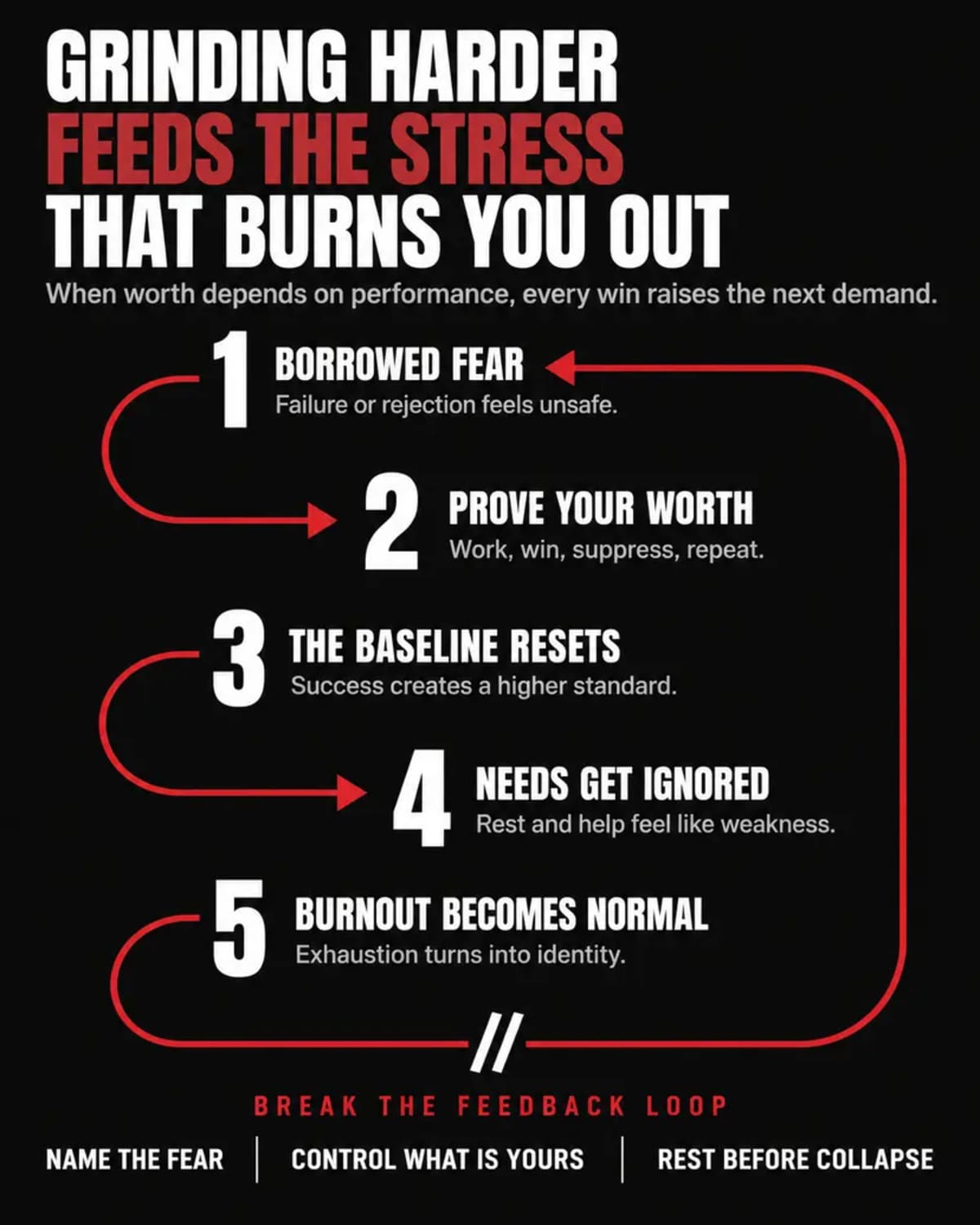
The research on this is blunt. Winning a competition recalibrates the scoreboard. Victory increases preference for higher-status products and resets the baseline, so each win manufactures a new standard of insufficiency. Rivals who resemble each other compete hardest, which means the closer you get to the men you emulate, the fiercer and emptier the race becomes.
This is the race to become the richest man in the trap. You can win it. Men do, every year. The prize is a bigger cage with better furniture, and a nervous system that never once stood down.
The trap has no finish line because it was never designed to have one. The survival economy runs on competition, comparison, and consumption, and it never declares enough.
Grinding Harder Deepens the Dilemma
The dominant answer sold to men right now is to grind through it. Suffer more, sleep less, outwork the pain. The Goggins-style doctrine treats suffering as the price of admission and treats your body as a machine built to maximise output.
Applied to the masculine dilemma, that method fails on its own terms. The problem you carry is an internal program driven by fear of abandonment and failure. Grinding harder feeds that exact program. You bury the wound under more performance, more stress, more proof-of-worth, and the wound compounds underneath the busyness. Burnout experts have made the same case, calling hustle culture a dangerous myth. When you hit depletion, the grind does not ease off. It tends to push harder. The people who hold up the longest are the ones who use rest and replenishment on purpose.
Think about what grinding means in any machine you actually rely on.
A well-built engine runs quiet. Grinding is friction. Grinding is the sound of metal destroying metal. When a mechanic hears grinding, he shuts the machine down immediately, because grinding means the system is broken and running it harder will destroy it.
Your clenched jaw at 3 a.m. is that sound. Around 70 percent of teeth-grinding cases trace back to stress and anxiety, with men at elevated risk. Your body is reporting friction in a system you keep redlining.
The rule on this path is the opposite of the grind. Stop. Stillness, reflection, and rebuilding from the inside out. The world calls that weakness. I call it the only move that interrupts the program instead of feeding it.
The Seven Stages of Burnout, Named Plainly
Burnout follows a sequence. Learn it, because the program hides each stage behind a flattering label.
Stage 1: Compulsive ambition. High energy, intense drive to prove yourself. It looks like commitment from the outside. It is an unsustainable foundation.
Stage 2: Stress onset. Fatigue, irritability, trouble concentrating. Motivation dips. You call it a rough quarter.
Stage 3: Neglecting your needs. Sleep slips. Meals slip. Time with people you love becomes negotiable. You get sick more often and push through it.
Stage 4: Burnout symptoms emerge. Brain fog, decision fatigue, drained before the day starts. Chronic headaches and stomach problems arrive. The body files reports you keep shredding.
Stage 5: Displacement. You blame the job, the wife, the market. The program protects itself by pointing outward.
Stage 6: Withdrawal. Detachment from the people and work that once mattered. You are present in body and absent in every way that counts.
Stage 7: Habitual burnout. Exhaustion and detachment become your baseline. At this stage, the condition usually requires medical help, because you can no longer cope with it alone. The four core symptoms are documented: exhaustion, emotional impairment, cognitive impairment, and mental distance.
Locate yourself honestly on that ladder. The program will tell you that you are at stage two when you are at stage five. Write your answer down, in ink, and let it unsettle you. The unsettling is information.
The Way Out Runs Inward
The exit opens through three moves, and each one is work you do rather than content you consume.
Name the program. The next time the chest tightens over a deadline or a comparison, trace the reaction back to its installer. Ask when you first felt this fear and whose approval you were chasing at the time. Ask whether the desire driving you is yours or copied from a man you were trained to emulate. Vague distress owns you. Named distress loosens.
Separate what you govern from what you cannot. You govern the integrity of your next action, the standards you practice daily, and whether you tell yourself the truth. Market swings, other men's opinions, and the scoreboard rankings sit outside your territory. Treat them as weather. The moment you narrow your attention to what is actually yours, your nervous system gets its first evidence that it is safe to stand down.
Stop before the machine seizes. Take an evening of rest you did not earn. Tell one trusted man the truth before a crisis forces it out of you. Write one honest sentence each morning instead of a paragraph of sophisticated noise. Small, repeated, unglamorous acts teach the old program that the predicted abandonment never arrives.
I offer my own life as data, from a man with nothing left to sell you except the work. I have been wealthy and broke, married and alone in the rubble. I rebuilt more than once. Today I own close to nothing and sleep better than I ever did while winning the race.
The stress was never normal. It was installed, inherited, and rewarded. The grinding you hear in your own system is the signal that the machine is broken, and running it harder will finish it.
STOP. Inspect the program. Govern the territory that was always yours. The second half of your life starts there.