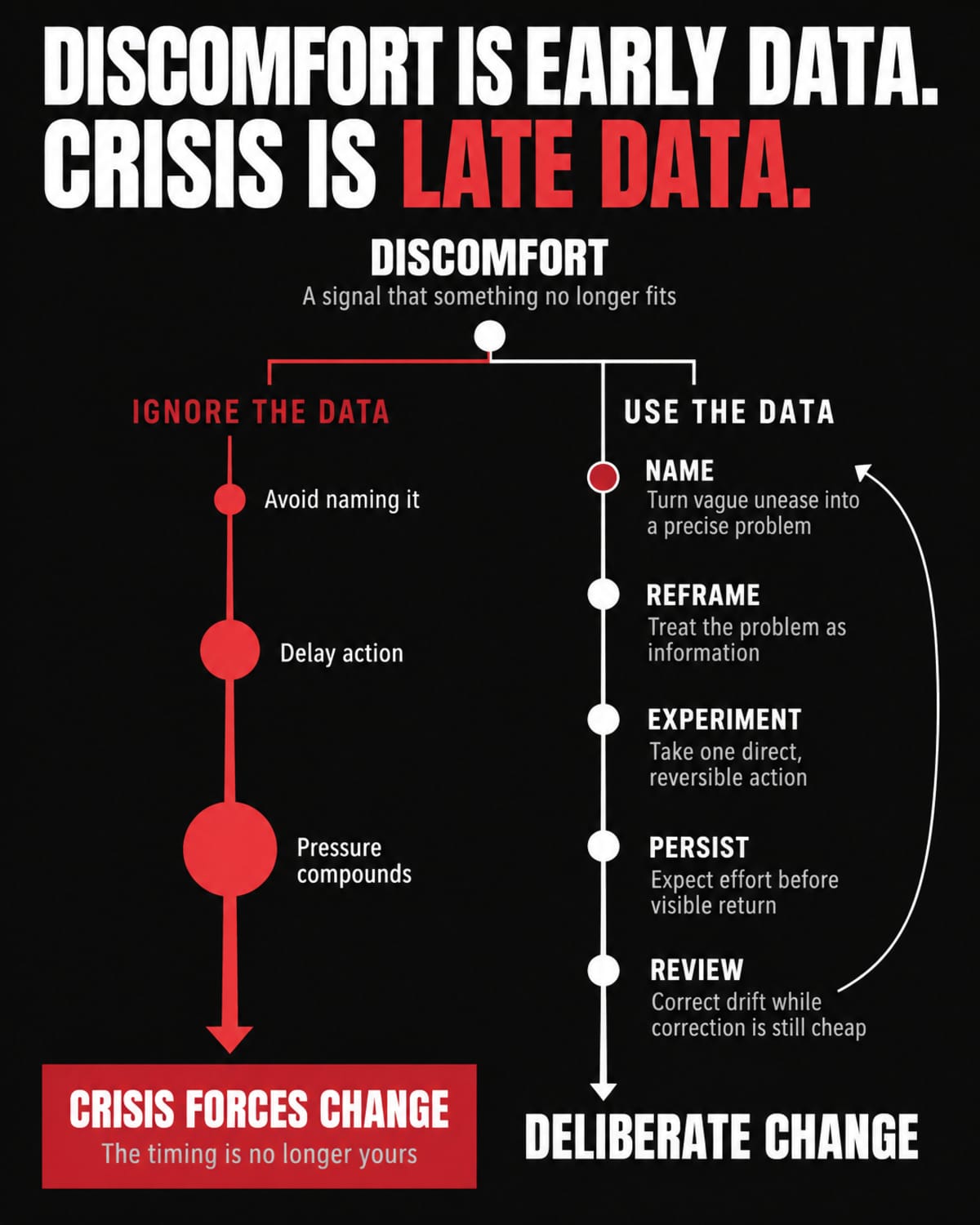
You hit 40, and something quiet starts talking to you.
The career works. The bills get paid. The boxes you were told to check are mostly checked. And still, there is a discomfort sitting under all of it that refuses to leave.
That discomfort is information. Men ignore it for years because ignoring it feels safer than naming it. The problem with ignoring it is simple: the discomfort compounds. It shows up later as burnout, divorce, health collapse, or a crisis that picks the timing for you.
The 5M Method exists for exactly this moment. It gives you a structure for the transition most men attempt with no map at all. Five stages: Motivation, Mindset, Movement, Momentum, Maintenance. Applied deliberately across the four areas that decide your quality of life: relationships, happiness, career, and health.
What the method really sells is time. You have everything else. Time is the one resource you cannot buy back, and the gap between who you are now and who you intend to become is measured in it. The 5M Method shortens that gap.
Motivation: Name the Discomfort You've Been Avoiding
Everything starts with honesty about pain.
Motivation in this method means identifying the problem instead of ignoring it. The feeling. The situation. The thing you talk around at dinner parties and lie to yourself about at night.
For men over 40, this takes real courage, because you built an identity on competence. Admitting that something inside the machine is broken feels like admitting failure. It isn't failure. It's the first accurate data point you've collected in years.
Maybe it's a marriage running on logistics instead of connection. Maybe it's a career that pays well and means nothing. Maybe it's a body you stopped listening to a decade ago.
Acknowledge the discomfort. Sit with it long enough to name it precisely. Vague dissatisfaction produces vague effort. A named problem produces a direction.
Crisis is the doorway here, not the disaster. The men who transform are the ones who stop pretending the pain is temporary.
Mindset: Activate the Opportunity Perspective
Once you've named the problem, your perspective on it decides everything downstream.
Mindset is the practice of inner observation. You watch your own thinking and notice where you've installed a problem perspective by default. Then you deliberately replace it with an opportunity perspective.
This is a trained skill, and it works like this:
- The job you resent becomes evidence of what you actually value.
- The strained relationship becomes a mirror showing where you stopped showing up.
- The health decline becomes the clearest feedback loop you own.
Positive thinking tells you to feel good about a bad situation. The opportunity perspective tells you the situation contains the raw material for your next move. Those are very different practices.
Most of your current thinking was installed by institutions that never had your best interests at heart. Schools, employers, media, the entire approval economy. Seeing that clearly is itself the mindset shift. When you stop performing for an audience that was never really watching, you free up enormous energy for the work that follows.
Movement: Take Experimental Action Toward the Edge
Insight without action is entertainment. Movement is where the method gets physical.
Movement means taking new action as an experiment. You move toward the edge of old familiar discomfort on purpose. You try the thing, observe the result, and adjust. No experiment fails, because every experiment returns data.
Here's the part men need to hear going in:
Movement runs at a 10:1 ratio. Ten units of energy produce one unit of change.
You put in a lot, and the results look subtle. You have the hard conversation and the marriage improves slightly. You train for a month, and the mirror barely notices. You start the new venture and the first results are modest.
This is where most men over 40 quit. They interpret the subtle return as proof the effort is pointless. The ratio is simply the physics of early change. Incremental increase. Elusive expansion. It's supposed to feel like this.
Pick one experimental action in each of the four life areas this week. Small action counts. Directed action counts more.
Momentum: Where the Math Flips in Your Favour
Keep moving long enough, and something remarkable happens.
Momentum runs at 1:10. One unit of energy now produces ten units of change.
Momentum is where all your prior effort gains significance. The results become tangible and visible. The habits carry you instead of you carrying them. The exponential curve you were promised finally shows up, and it shows up because you paid the 10:1 price first.
You've felt this before in smaller arenas. The first months of training that felt like nothing, followed by the season where strength arrived in waves. The early years of a career that felt like pushing rock, followed by the stretch where opportunity found you.
The 5M Method asks you to trust that same physics with your whole life.
Your job inside momentum is to keep it pointed at the opportunity perspective. Momentum amplifies whatever direction you feed it. Feed it drift and you get accelerated drift. Feed it intention and you get accelerated becoming.
Maintenance: The Discipline That Makes It Permanent
Maintenance is the stage almost every self-development program skips, and it's the one that separates a permanent transformation from a fleeting phase.
Maintenance means intelligent course correction as a lifecycle practice. You review honestly. You notice where you've drifted back toward the old comfortable cage. You correct early, while the correction is still cheap.
A working maintenance practice looks like this:
- A regular, honest review of all four life areas
- Willingness to restart the cycle at Motivation when new discomfort appears
- Discipline applied to the practice itself, not just the goals
Then you repeat. Forever.
That word matters. The 5M Method describes a life practice rather than a program you complete. New discomfort will arrive, because you're alive and growing. Each time it arrives, you now have a structure: acknowledge it, reframe it, act on it, compound it, maintain it.
Complacency is the real opponent in the second half of life. Maintenance is how you deny it a foothold.
The Four Areas, One Method, Your Next Forty Years
Apply the full cycle to relationships, happiness, career, and health. Each area gets the same five stages. Keep everything simple. Complexity is usually avoidance wearing a smart disguise.
Here's what I know from living through collapse and rebuild more than once: the men who make it to a meaningful second half share one trait. They stopped waiting for permission. They treated their crisis as the invitation it was and did the work in order, stage by stage. This is your absolute opportunity perspective in action.
The first half of your life ran on programming you didn't choose. The second half can run on structure you build deliberately.
Start with Motivation tonight. Write down the one discomfort you've been managing instead of facing. Name it in a full sentence.
That single honest sentence is the beginning of Movement. Everything after that is momentum waiting to happen.
Time is now. The method is simple. The work is yours.