A man over 40 with the title, the income, and the respect of his industry will tell you he is prospering. He believes it. The numbers back him up.
Then he sits in his car on a quiet Tuesday night and admits he feels nothing about any of it.
I know that moment from the inside. I chased the approved markers of winning, reached several of them, and found the hollow centre waiting for me. I have been wealthy and broke. I rebuilt from ruins more than once. So I speak from direct experience when I tell you this:
What you call prospering is often survival mode running a convincing performance.
Conditional Worth Looks Exactly Like Success
Here is the mechanism, stated plainly.
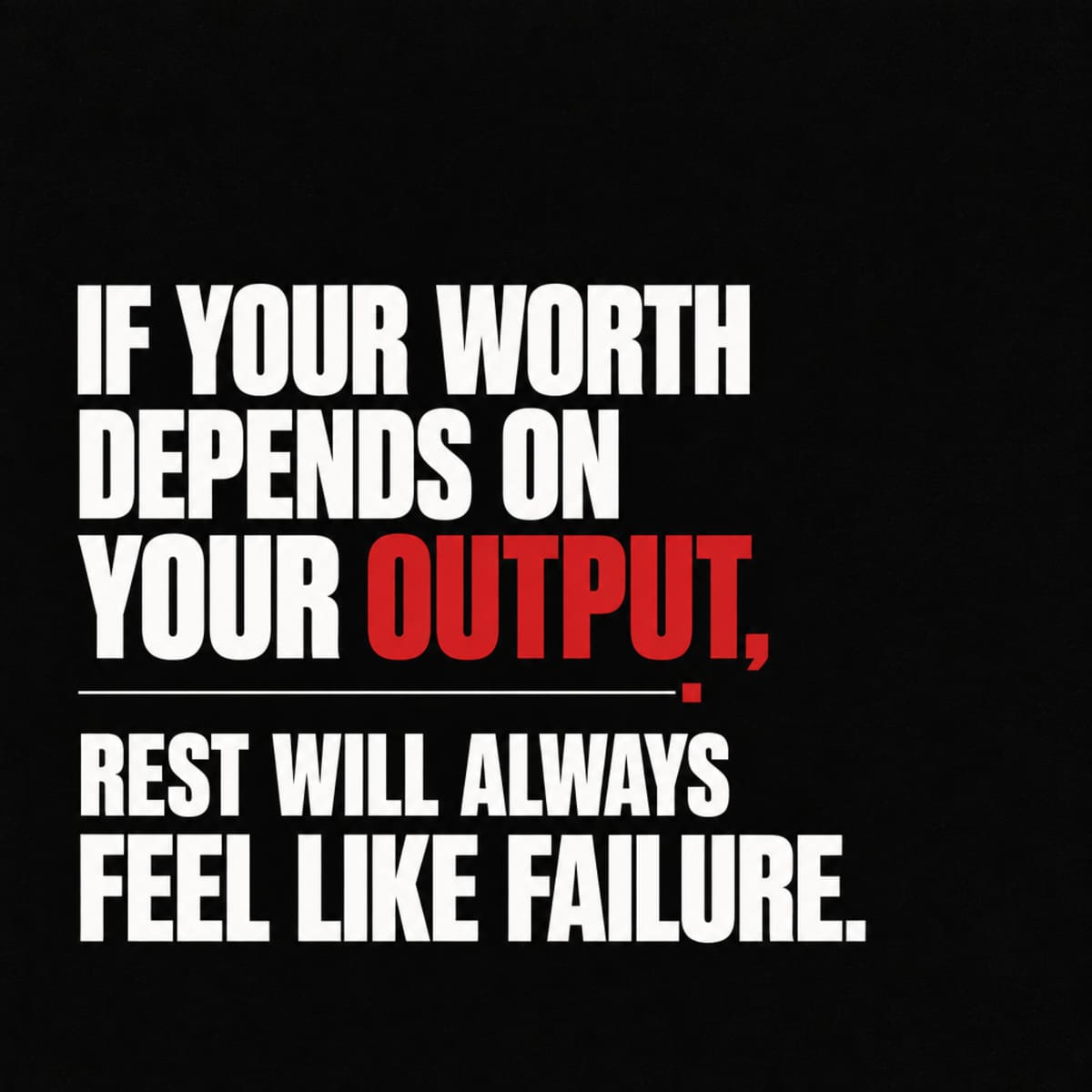
When your value is conditional, tied to output, achievement, and the approval of others, you work relentlessly to keep the conditions met. That relentless work produces results. The results look like thriving.
Underneath, you are hanging on to slim winnings and brittle strings. Duck paddling on steroids.
This kind of worth is inherently unstable. Research on conditional self-worth shows that when your sense of self depends on productivity or approval, it holds while you perform and collapses the moment you slow down, fall behind, or disappoint someone.
Your identity becomes a lease. The landlord renews it daily, based on yesterday's numbers.
You feel this already. It shows up as the inability to rest without guilt. The flinch when praise lands, because the praise lands on the mask. The low hum of dread on Sunday night that you have learned to call ambition.
Everything Around You Tells the Truth About Your Position
The systems you perform for are honest about one thing. They value your utility.
Your employer values your output. The culture values your compliance with its script for manhood. The institutions that installed your programming never had your interests at heart. You are a cog in their wheel, there to serve their needs and their agenda, and you remain expendable the day your output drops.
This sounds harsh. It is also a relief, once you accept it.
The usefulness of your position is the signal that your purpose is still outsourced. You have no other purpose until you live your own. Accepting that fact, fully and without flinching, is the beginning of freedom rather than the end of hope.
The data describes the cost of refusing to accept it. Men account for 75 percent of workplace stress-related absences, and 40 percent of men report burnout at work, with many suffering in silence. A survey of 15,000 employees found men are twice as likely to develop mental health problems from their job compared to problems outside of work.
The cage produces the injury, and the programming forbids you from naming it.
The Programming Was Installed Before You Could Consent
You absorbed the rules early. A man's value equals his productivity. A man suppresses what he feels. A man handles everything alone.
These rules feel like your personality. They are software.
Research confirms that four specific masculine ideals, prioritising work, extreme self-reliance, the pressure to win, and emotional control, predict emotional suppression with a correlation of 0.521. You were graded on all four your entire life.
The body keeps score of the performance. Habitual suppression predicts chronic physiological dysregulation across a man's life. The same conditioning that creates the distress forbids you from asking for help with it.
That is the full shape of the trap. The water poisons you and tells you the poison is normal.
Crisis Is the Doorway You Have Been Avoiding
Men whose worth is conditional rarely wake up while the conditions are being met. Comfort keeps the illusion intact.
Then something collapses. The marriage. The position. The health. The promotion that arrived and meant nothing.
The timing is predictable. About 75 percent of men experience some form of midlife crisis, with life satisfaction bottoming out around age 47. The collapse arrives on schedule because performance has a shelf life and identity demands something permanent.
Crisis is the doorway. The collapse reveals the distance between the man you perform and the man you are. That revelation is the only honest starting material you will ever get.
You face a choice at that moment. Numb yourself back to sleep, or look directly at the machinery that has been running you.
The men I work with choose to look. I offer them reframe instead of rescue, because reframe produces transformation and rescue produces dependence.
The Audit That Breaks the Autopilot
Perspective is the variable that matters. Change how you see your situation and everything downstream shifts. Here is where the seeing starts.
I put three questions to every man in the first week of our work together:
- Whose voice sets your calendar? Walk through your week and name the author of each commitment. Much of what you call your schedule was written by your employer, your industry, and expectations you absorbed decades ago.
- Which wins actually felt good? List your last five achievements and sit with each one honestly. The wins that produced relief instead of satisfaction were survival moves. Relief means you escaped punishment. Satisfaction means you built something you chose.
- What would you keep doing if no one saw it? Strip away the audience and watch what survives. Whatever remains is yours. Everything else was performance for a scoreboard someone else installed.
Write your answers down. Vague discomfort stays unworkable, and naming it converts it into material you can act on.
Expect the answers to sting. The sting is information.
Living From Internal Authority
The work after the audit is daily and unglamorous. You trace every pursuit back to its source and ask who originally wanted it for you. You act on the pursuits you actually chose and let the borrowed ones expire.
You practice stillness while the culture tells you to grind harder. The water clears when you stop stirring it.
You rebuild your measure of success from the inside. Self-chosen purpose replaces the external scoreboard, and your worth stops renting itself out to outcomes and approval.
Something irreversible happens once you taste this. You live a day, maybe an hour, without managing a single impression. After that, the old performance becomes intolerable. You will be unable to unknow it.
I will be straight with you about the stakes. Inaction is itself a decision. You either take responsibility for the condition of your inner life through conscious, progressive effort, or you declare by default that you prefer the cage. Inaction preserves your dirty water.
The system was always honest about what you are to it. The sooner you accept your position as a cog, the sooner you stop negotiating with the wheel and start building a life that belongs to you.
Start tonight. Answer the three questions on paper and sit with what comes up. That is the first act of a man who runs his own life.